Yanuni Review: Fighting the Apocalypse in the Tropics
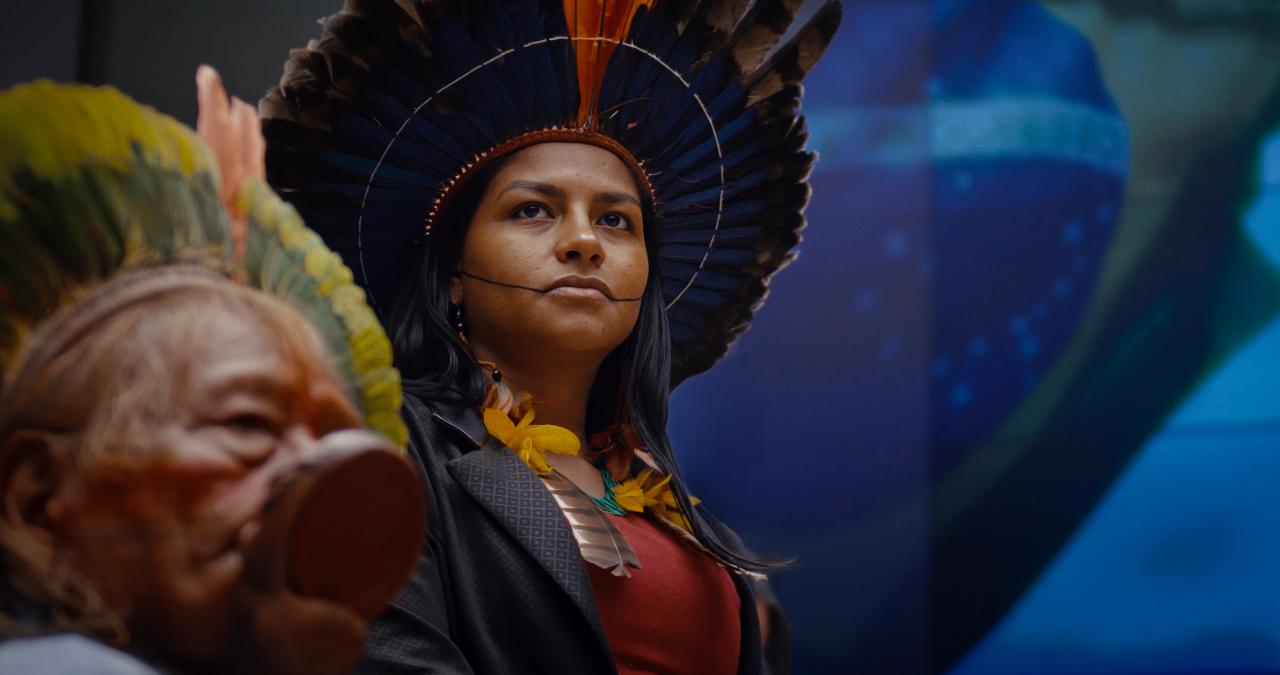
Indigenous activist and leader Juma Xipaia proves one of the most memorable characters you'll meet in a documentary this year as Yanuni follows her fight to protect the Brazilian Amazon. The post Yanuni Review: Fighting the Apocalypse in the Tropics appeared first on POV Magazine.
Yanuni
(Austria/Brazil/USA/Canada/Germany, 112 min.)
Dir. Richard Ladkani Prod. Anita Ladkani, Richard Ladkani, Juma Xipaia, Leonardo DiCaprio, Jennifer Davisson, Phillip Watson
A nation’s struggle to realise its commitments towards reconciliation for Indigenous communities finds a gripping case study in Yanuni. This intense character piece turns the lens on Indigenous activist and land defender Juma Xipaia. The 34-year-old leader of the Xipaya people was also the first woman to serve as chief of Brazil’s Middle Xingu region and she embodies a generation with renewed fire. Xipaia is one of the most memorable characters that audiences could meet in a documentary this year, and she’s a powerful, compelling, and articulate advocate for a worthy cause. Her indefatigable quest to fight for her people and the land that fuels generations of culture, history, and heritage has many echoes in stories of Indigenous activists in Canada.
This compelling film, which was recently shortlisted for the Best Documentary Feature Oscar, observes Juma as she advocates for environmental protectionism, specifically through an Indigenous lens. She focuses on issues of illegal mining that have devastating consequences for the Amazon. Director Richard Ladkani, who followed Juma over four years and learned Brazilian Portuguese to communicate with her—both to learn her creative interests and to eliminate the security risks invited by outside translators—offers an environmental rallying cry that speaks to the urgency of the situation that inspires an activist to commit her life to a cause.
The film opens with a bracing jolt as Ladkani’s camera accompanies Juma during an environmental protest in which demonstrators clash with police in the streets of Brazil. Events turn sour quickly. The crowd disperses as the police open fire. As Ladkani’s camera navigates the chaotic human flow as some demonstrators run cover while others stand their ground, the image cuts to the Xipaia leader appears cradling the body of one of her neighbours. In its first moments, Yanuni viscerally conveys the gravity of the fight: People are literally dying while protesting for the environment. It’s a harrowing scene as Juma and her colleagues try to move their friend’s limp body while the police rain bullets and gas in their direction. .
These images, caught from the tail end of Jair Bolsonaro’s reign of terror, encapsulate a period of populist politics in Brazil where Indigenous rights were trumped by economic ambitions and currents of Brazilian nationalism. They’re also a fair snapshot for events that precede the action that audiences see in Yanuni. By the time we meet Xipaia, she’s already survived six assassination attempts. The documentary unfortunately doesn’t dive further into those stories, as both the protagonist and the filmmaker prefer to focus on the present fight, but it becomes immediately clear how advances for Indigenous land rights within the resource-rich Amazon might make Xipaia a target for corporations and off-the-grid smugglers alike.
However, Ladkani contrasts this intense sequence with one that offers an inspiring alternative. Cut to an election later, and Bolsonaro is out and Luiz Inácio Lula da Silva is in. Lula’s election, which readers can learn more about from the documentary Apocalypse in the Tropics, seemingly represents a change of fortune, although this documentary illustrates that there’s far more work to be done. Lula’s term sees the creation of the Ministry of Native People—a sort of “Indigenous Affairs” folder, but handled by people who are actually Indigenous. It taps Sônia Guajajara as Minister, while Juma lands the cumbersome if appropriate title of Secretary of Articulation and Promotion of Indigenous Rights.
This role puts her activism on the world stage and give her voice a platform. She uses the spotlight well. The documentary observes the devastating effects of industry on the Amazonian watershed, from water pollution from gold mining to deforestation for lumber and cattle farming. The film then introduces a pivotal character in Xipaia’s personal and professional life. Her husband, Hugo Loss, heads up special operations in the Brazilian Institute of Environment and Renewable Natural Resources (IBAMA). His storyline departs from Yanuni’s lyrical cadence and serve effective punctuation marks to rouse audiences from their slumber, although the divergence of styles invites some issues of pacing. Moreover, Xipaia learns that she is pregnant and the safety of their future child necessitates a remove from the action, although the stress of the fight still takes its toll.
As Ladkani accompanies Loss, Yanuni finds some truly extraordinary work in action. Loss scouts illegal gold mining operations and ceases their existence by force. He and his crew literally blow up barges in the Amazon, like mercenaries sent to right the wrongs of environmental pirates. As IBAMA’s boats traverse the Amazon, one sees how the colour of the water changes from muddy brown to metallic black. It’s a firsthand view of mercury contamination and the consequences of illegal resource extraction that Xipaia and her colleagues seek to contain. This operation should blow away audiences as IBAMA’s enforcement missions play like something out of a war movie. The reality is that the fight in the Amazon is a war of its own kind and Yanuni shares a view from the front lines.
But the sequences with the IBAMA team, which include exchanges of heavy artillery and close calls with explosions, may have audiences questioning the legality of their operations—a point that more than one audience member queried executive producer Laura Nix at the Palm Springs International Film Festival—but the action is as Ladkani shows it. These are legal and government funded operations. It might shock audiences to see environmental protection look like a SWAT team, but Yanuni serves a reminder of the necessity of radical action. This tough enforcement complements the efforts that Xipaia, Guajajara, and their colleagues seek to inspire through policy.
Yanuni, much like Alex Pritz’s 2022 doc The Territory on the Brazilian Amazon, emphasizes Indigenous perspectives while navigating a collaborative approach to storytelling. Xipaia receives a producer credit alongside big names like Leonardo DiCaprio, and story follows her lead in terms of perspective and lenses both macro and micro. This framing focuses on the personal stakes in environmental activism and serves solutions-based cinema on the heels of other docs that have already identified the problem. Yanuni offers activist cinema with an artful lens.
While some efforts in the environmental fight prove stillborn, Xipaia and Loss’s child encapsulates the hope they carry through their respective missions. Loss shares that Juma hopes to name child Yanuni in homage to a small black bird with a red beak. It’s a touching reminder that Xipaia and her contemporaries fight not just for their families, but for all living things in the Amazon. This character-driven eco doc that explosively challenges the complacency of anyone who watches it.
Yanuni is now screening on the festival circuit including Palm Springs and Reframe Film Festival this January.
The post Yanuni Review: Fighting the Apocalypse in the Tropics appeared first on POV Magazine.
Related Articles

Visions of the Croisette: The Ultimate Prediction for the 2026 Cannes Film Festival Main Competition
Caught between streaming algorithms and geopolitical upheaval, does cinema’s “sacredness” still matter? A Los Angeles–based team predicts the 22 Palme d’Or contenders for Cannes 2026—from PTA and Östlund to Panahi, Rohrwacher, and beyond.

Exposing the Dark Truth of Digital Totalitarianism: Documentary 'Eyes of the Machine' Arrives in Prague as One World Film Festival Opens
Following its acclaimed premiere at IDFA Amsterdam, investigative documentary Eyes of the Machine screens at One World International Human Rights Documentary Film Festival in Prague, with Uyghur witness Kalbinur Sidik attending in person.

The Theft Review: Reclaiming Afghanistan’s Cultural History
Efforts to repatriate artifacts and artworks stolen from Afghanistan invite wider considerations of cultural history in Aisha Jamal's The Theft . .