How Under the Arbor Celebrates the Collective Spirit of Powwow

An interview with Under the Arbor director Hayley Morin and producer Mack Stannard about capturing Powwow celebrations and the personalities behind them.
In filmmaker Hayley Morin’s feature directorial debut, Under the Arbour, we get unprecedented access to the heart of the Powwow trail. The film, which premieres on CBC Gem on August 15, is an intimate and look into the stories of the people who work tirelessly in organizing and participating in Powwows. Shot over one summer across Treaty 6 territory, where Morin was born and raised, the film intersperses the personal attachments that individuals have to the Powwow with glorious footage of champion dancers, grassroots drummers, and musicians to neatly construct the personal and communal relationships that are at the forefront of Powwow.
Featuring renowned names including dancer Danni Okemaw, musician Fawn Wood, singer Dallas Waskahat, and master of ceremonies Hal Eagletail, to name a few, Under the Arbor is rife with raw, personal commentary discussing in detail Indigenous culture, art, expression, and the necessity for celebration, inclusivity, and connection for any community hoping to find joy in togetherness. Working alongside producer Mack Stannard and director of photography Michael Bourquin, Morin, a member of the Enoch Cree Nation, has crafted a contemporary outlook towards Powwow which offers a novel insight into Indigenous culture from a lens that is not only relevant but of the essence today.
POV spoke with Hayley Morin and Mack Stannard via Zoom ahead of the film’s release on CBC Gem.
POV: Nidhil Vohra
HM: Hayley Morin
MS: Mack Stannard
This interview has been edited for brevity and clarity.
POV: Why focus on Powwow specifically, and what importance do you think it holds historically, but also in today’s time?
HM: Powwow was such a big part of my life from such a young age that it became so normal to me that I didn’t realize the weight of what it was, because it was just an everyday summer thing. As I got older and as I got more in touch with my culture and people came into my family that held more of that lifestyle – that Powwow drum lifestyle – it felt like it brought a lot of meaning into my family’s life. For a lot of my early career, it always felt like something that I would love to watch a film on. I feel like for so long I was searching for it or hoping someone would make it one day. A realization hit me one day when I was talking with Mack and I was like, ‘I don’t think it’s worth waiting for anymore.’ The story and the community are valuable and interesting enough that I thought that we could do something really special and show this community in a light that they’ve never really been able to do before. So being able to do that with Powwow and being able to tap into not only my cultural roots and my family history, but just being able to come back to my homeland, do a project on something that feels so integral to the land here and to my people, it felt like kind of a no-brainer that Powwow was the next thing that deserved to have a big spotlight on it.
POV: In the film, there’s a lot of personal emotion grounded within Powwow that comes across both visually, but also when you hear people talk about it. How connected do you think the personal is to the communal when it comes to Powwow?
HM: With Powwow, something that’s really special is that it is such a communal event, but also it is quite an individual journey. When you engage in that Powwow lifestyle—and you hear it a lot in the film from our lead singer Dallas, and our lead dancer, Danni Okemaw—when you’re dancing, when you’re singing, a lot of the people who are coming to watch you [are] coming to watch you to take things away from your dancing and your singing. So, when you’re in that sort of space with the culture and the creator, a lot of things are being called to in that moment. When people are singing and dancing, sometimes they’re dancing for healing, sometimes they’re dancing for reconnection, sometimes they’re dancing for reconciliation. But the heart of Powwow has always been being able to create a space to call to Creator, to bring our ancestors in a way that is a joyful celebration. With Powwow, it’s really evident to see that you can have a moment with a dancer where you’re focusing on them and it feels like it’s only you and them within that arbor, and then 10 seconds later, you can look over and see 50 people at a drum shoulder to shoulder. That’s the kind of unique thing about Powwow: it feels like there are 10 people and a thousand people in the same room at the same time.

POV: How do you think cinema and Powwow are correlated as sites of healing?
HM: Nidhil, you’re going to join me on my TED talk right now. (Laughs.) Obviously, throughout my career and especially in the last five to 10 years, the conversation of representation and reconciliation has been huge, and is finding itself into the media spaces and into the art that Mack and I do. A big thing for reconciliation is the modernization of Powwow and bringing it into the forefront. Being able to show that on screen in a visually pleasing way and in a very intimate and professional way is huge for a lot of the conversations that we’re having. The basis of the film is, of course, celebrating Powwow and being able to give a spotlight to a lot of these individuals that have been putting decades into this community.
MS: Haley really wanted to talk about now, and talk about the future, and talk about where we go from here. For me as an outsider to the culture and to the experience, it was incredibly fascinating and something Haley wanted to bring. Part of the film that, I think, she did a great job with is [when it is] talking about Powwow as a modern event and a living breathing thing that changes throughout a season and over the years. It’s not a relic of the past: it has a history, but that it’s alive today and it’s changing. Those visuals of somebody wearing their street clothes at the Powwow and feeling comfortable in it, that’s not an image that an outsider would have in their head, but that is a perfectly normal thing at a Powwow I’ve come to learn now.
POV: How did you craft the visual appeal and the appearance of the film to be balanced, authentic and sensitive towards the characters? What are your thoughts on the Hollywood-ization of Indigenous stories through films like Killers of the Flower Moon?
HM: It’s so funny because when Mack and I were in the development process, that shot from Killers of the Flower Moon [an overhead view of Indigenous people beating a drum and dancing] was in our deck and it was something that we referenced heavily, which was great. But that image and reference actually sparked a bigger conversation within me because when we were building our development and when we were looking at what the tone of the film was going to be, the visual language, and it was time for us to look at other people’s projects, there wasn’t a lot available for Powwow representation. Having that gap in the market sparked a big thing for me. If I’m looking for this as a young established filmmaker, I can’t imagine how many other people are also looking for it.
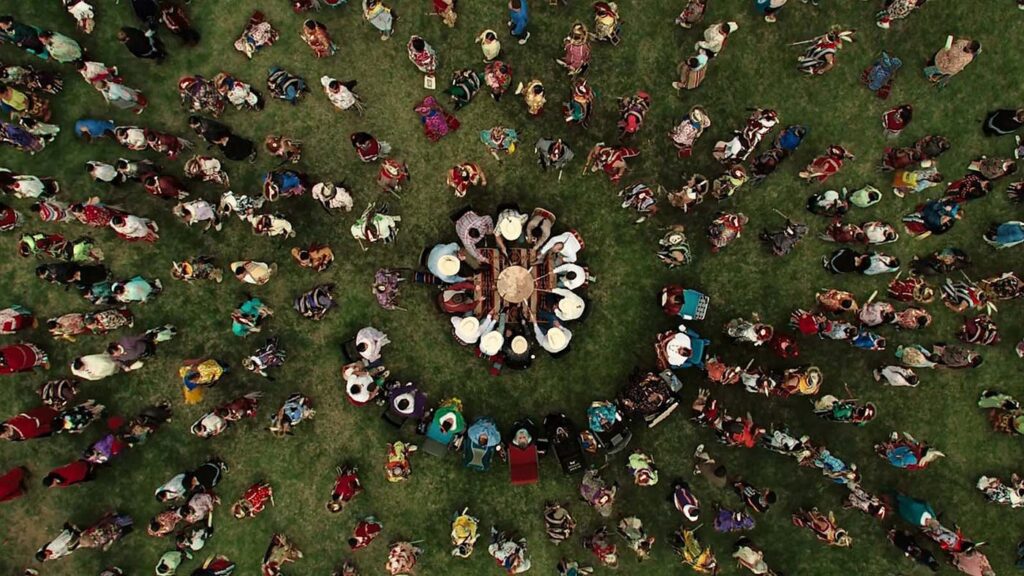
When when you look at these big blockbuster movies like Killers of the Flower Moon, or a [series like] Yellowstone or a lot of popular media that’s happening right now, the gaps that you’re finding, that a lot of Indigenous people are looking for, is because it’s not being told by Indigenous people.
Me coming as a band member, as an Indigenous filmmaker, I feel like I was able to access a lot more vulnerability within people because I knew the proper way to go about things. I knew there were moments in the process of filmmaking where we had to take cameras down for cultural reasons or because we didn’t want to show our subjects being injured at times. Sometimes an artistic instinct would to be make it gritty and show everything: the good, the bad and the ugly. There has been so much space for that in Indigenous media [for] so long that it felt like, for the first time, I was like, ‘I just want to show something really nice and celebratory.’
We started looking at the other things that are working for other industries like a Drive to Survive, LIV Golf or things that are having these big docuseries moments and looking deeper into the sport. When I watch shows like this as a girl in my twenties, or one that lives in Alberta, I didn’t know the F1 existed until two years ago, and then after I watched that show I was like, ‘I’m Daniel Ricardo’s biggest fan’. So, being able to go into our project like that seeing Fawn Wood, seeing Dallas Waskahat, seeing Hal Eagletail—why can’t we treat them like a Max Verstappen?
Because to this community, that’s who those people are. One of the biggest rewards I’ve had through this is being able to go through the comments and reading, “I see you in the film,” or “Oh my God, I love Hal,” or “Fawn Wood is my niece’s favorite musician.” These are very prolific people within this community, but also they’re in the community: they’re at the drums, they’re in the stands, they’re in the MC booth. Being able to really bridge that gap was a big priority for us.

POV: What do you think of the status of Indigenous stories within Canada specifically, and how have you seen the landscape evolve over the past few years?
HM: We’re in a really interesting time for Indigenous representation. Over the past couple of years, I’ve been so fortunate to see and be a part of a lot of the progress that has happened. I’ve worked on various documentaries, I’ve dabbled my foot into the narrative world working on films like Hey, Viktor! and Smudge the Blades that is coming out soon. The fact that I’m able to say that proves how far we’ve come in the last couple of years because 10 years ago when I was in film school, I remember saying very, very adamantly, “I don’t know if I want to work on Indigenous stuff because I’m scared that that’s going to dry up one day.” Or, “I’m scared that I’ll niche myself out into a place where I don’t know if I’ll have a full career like a James Cameron or a Christopher Nolan.”
Fast forward 10 years now and I can say I spent my entire twenties making a life off of telling Indigenous stories and pretty much only doing Indigenous films at this point. We’re in a space now where films like Under the Arbor are able to exist, where it’s not about residential schools, it’s not about the Sixties Scoop. We’re able to transition to a movie like Smudge the Blades, where it’s all about res hockey or other cool things where we talk about Indigenous snowboarders or Indigenous skateboarders like Joe Buffalo.
A big problem too is that because there wasn’t a lot of Indigenous representation, a lot of the stories were super broad. So, you would go into an hour about all the bad things that happened to native people set in a residential school in B.C. Now, because a lot of those stories were told, and it was really important that they were told, we’re in a place in Indigenous media where we’re able to say, “Let’s watch a film about a native skateboarder. Let’s watch a film about a native doing Powwow.” Being able to have spaces like that and being able to have media representation like that is huge.
I would caveat with that in saying that that doesn’t mean it’s all perfect. It doesn’t mean that we’re all necessarily in the clear. Once you get too comfortable, it’s easy to lose things like that. We need to create an infrastructure for stories.
Under the Arbor debuts on CBC Gem, including a Cree version, on August 15. It will also be on CBC TV on August 16th in Alberta, BC and in the North.
Related Articles
How Twisted Yoga Centres Care Amid a Web of Lies
An interview with Twisted Yoga director Rowan Deacon and executive producer Suzanne Lavery on their true crime doc now streaming on Apple. .
The Roots of Black Zombie
Black Zombie director Maya Annik Bedward tells how her new documentary explores the Haitian Vodou roots of zombie culture. .

The Longer You Bleed Shares the Pros and Cons of Doomscrolling
An interview with The Longer You Bleed director Ewan Waddell about chronicling the invasion of Ukraine via doomscrolling and viral videos. The post The Longer You Bleed Shares the Pros and Cons of Doomscrolling appeared first on POV Magazine.