Faking It: Mockumentaries Tell the Truth — or Do They?
How mockumentaries like The Dirties , Punishment Park, and The Clowns play with our suspension of disbelief and the line between fiction and non-fiction. .
When filmmakers import the visual language of documentaries into a fictional milieu, staging awkward, whimsical and ridiculous situations for entertainment—as opposed to the genre’s noble mission of educating audiences or inspiring social change— we are in the realm of the mockumentary. The format has found success in the most unexpected settings, from the mundane to the mythical, in a Scranton branch of a paper company or the suburban residence of a vampire coven. Increasingly provocative as a genre, the upsurge that began with This Is Spinal Tap (1984) and Drop Dead Gorgeous (1999) reached new levels of popularity with Arrested Development (2003-2006), The Office (2005-2013), Parks and Recreation (2009-2015), and What We Do in the Shadows (2014).
In these films and TV series, characters knowingly stare into the lens and perform talking head-style interviews, aware that they’re being observed and recorded by a production crew. The observant camera zooms in dramatically and shakily, operated by hands desperate to capture a spontaneous event, as if the scene hadn’t been workshopped in a writers’ room and subsequently rehearsed for blocking on set.
A fictional work presented as a documentary, the mockumentary necessarily relies on the audience’s understanding of documentary traditions, manipulating them to subvert expectations, carry out political commentary, and interrogate filmmaking ethics. In addition to the pleasures of joy and laughter, mockumentaries have great potential to evoke confusion, anger, fear, anxiety, cynicism, intrigue, hope, compassion and enchantment. Though mockumentaries are closely associated with comedy, emphasizing a laughing or teasing register in “mock,” we might also consider alternative dimensions of the term. Drawing out a more artful, cunning definition of the prefix, mockumentaries also hold the capacity to imitate and deceive in service of generating other effects: mock as in artificial, fraudulent, simulated, an object forged in the image of an original with a hidden intent.
Like documentary, the precise origins of the mockumentary are difficult to locate given its evolving terminology and classification over time. Relying on the pre-existing conventions of another mode, it remains a particularly slippery genre that has been variously named, with different connotations associated with each proposed term: where “pseudo-documentary” suggests a false or sham quality, “spoof documentary” highlights its humour and parodic intentions. “Mockumentary,” or “mock-documentary,” though, appears to be the most generous, capturing the spirit of works that are more ambiguous, situated along the spectrum of comedic and dramatic.
Arriving a few decades after the first actualities and soon after Robert J. Flaherty’s landmark semi-documentary Nanook of the North (1922), Luis Buñuel’s short film Land Without Bread (1933) is an early example of the mockumentary. At first, it resembles a study of the Las Hurdes region of Spain, but viewers soon realise that Bunuel has different intentions with his film. Revealed to be increasingly unreliable and condescending, the narrator dispenses information about the residents of the mountainous area, exaggerating their isolation and poverty through voiceover anecdotes that cannot be verified. Indeed, two scenes were confirmed to be staged: a goat falling from a cliff was deliberately shot by a crew member, and a donkey being stung to death by bees had been slathered in honey. A surrealist response to anthropological and travelogue films of the era, Buñuel crafted an early form of mockumentary that remarks on our flawed ethnographic impulses.
Another work with subtler shades of mockumentary elements, Peter Jackson and Costa Botes’s Forgotten Silver (1995) chronicles the supposed lost works and innovations of New Zealand film pioneer Colin McKenzie. Presented as a straightforward documentary, Jackson appears on screen to share the forgotten contributions of McKenzie, whose reels had been abandoned in the shed of his parents’ neighbour. Miraculously recovered just before they deteriorated beyond recognition, they contain footage of not only undiscovered efforts, but films in sound and colour that predate the historically documented invention of these technologies.
Contributing to the film’s believability are purported archival photographs, videos and newspaper clippings, aged and degraded to suggest that they had been preserved and found rather than constructed. Jackson and Botes take care to sow suspicion, planting stories that sound too good to be true. In one instance, a voiceover claims that McKenzie independently formulated a film emulsion with egg whites and was caught stealing eggs in his youth with the intention of making a feature-length film. To authenticate this anecdote, the film displays a close-up shot of the newspaper headline, “2000 Dozen Eggs Stolen,” printed on yellowing paper in faded black ink. The film invites us to challenge the implicit contract between documentaries and viewers, asking how we know we can trust testimonies and documents to tell the truth. An exercise in engaging critical viewing practices, Forgotten Silver employs the mockumentary mode to comment on our relationship with media and mythmaking.
A film that reveals its duplicitous nature more readily, Matt Johnson’s The Dirties (2013) declares itself as a found footage feature that trails a fictionalized version of Johnson as a high school student. Matt, along with his best friend Owen, attempts to make a revenge fantasy film for a class assignment about their experiences getting bullied, replete with film references and excessive violence. The latter alarms a teacher who watches a rough cut in horror, demanding that these elements be removed. Frustrated by a lack of support and their worsening victimization, Matt has the distressing idea to shoot his gang of bullies—whose nickname lends the film its title—and record it for his project, arguing that society would ultimately benefit from the act. As Owen decides to pursue his crush, opening himself up to new people and experiences, Matt slips deeper into antisocial behaviour that convinces him to set his plan in motion.
Like the Belgian Man Bites Dog (1992), whose charismatic serial killer subject served as inspiration for Johnson, The Dirties similarly follows a disturbed individual through the frame of a mockumentary, gesturing to audiences that what unfolds across the screen should be regarded in a slightly different viewing position. The form prompts us to consider the relationship between the seemingly unscripted events taking place and the means through which they were documented, dissolving the boundaries between fiction and nonfiction. When Owen is physically and verbally assaulted in the cafeteria, the scene is shot from a distance, shakily, as if being witnessed by a fellow student who has later contextualized this instance of bullying as motivation for a school shooting. Though the film fails to consistently keep up the conceit, this overall strategy produces a sense of fear and unease by granting intimate access to a controversial figure.
At the same time, the assembled footage also encourages us to empathize with Matt, who feels helpless as a social outcast and turns to violence as a last resort. Portraying the character as a teenager lost in an identity crisis, the film offers a compassionate approach to understanding the phenomenon of school shootings. In an interview, Johnson has said that watching home video footage of the individuals behind Columbine in a documentary led to the realization he was not so different from them. He, along with so many, was a young man playing pretend and wanting to feel seen in front of a camera. Where a conventional narrative film might equally depict a sympathetic portrait—à la We Need to Talk About Kevin (2011), for example—the false documentary style orients the viewer in the mentality that Johnson describes for the entire duration of the film, compelling audiences to occupy the interiorities of Matt and Owen leading up to the shocking conclusion.
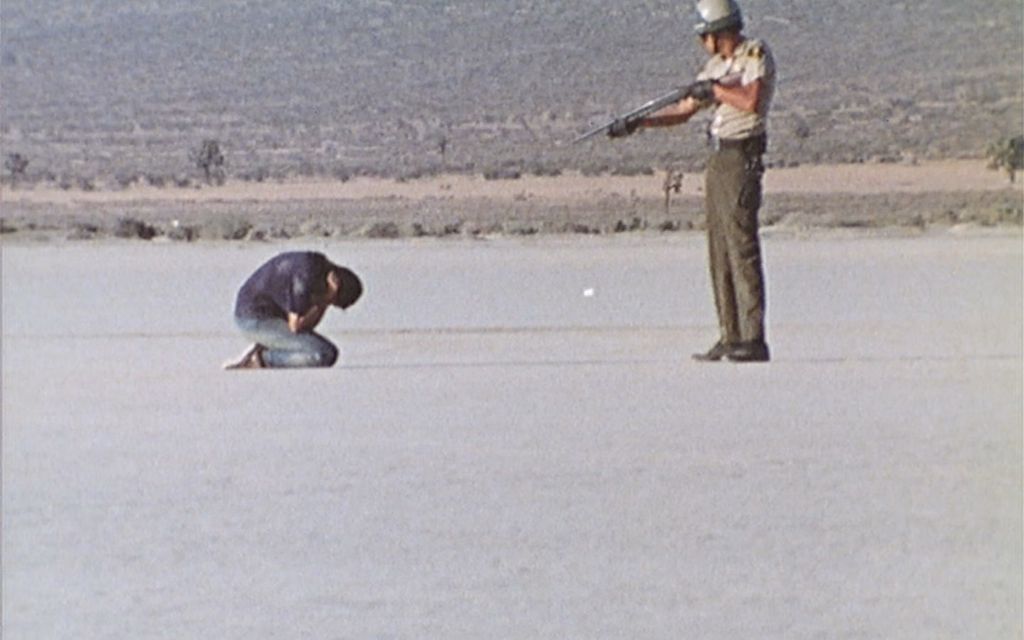
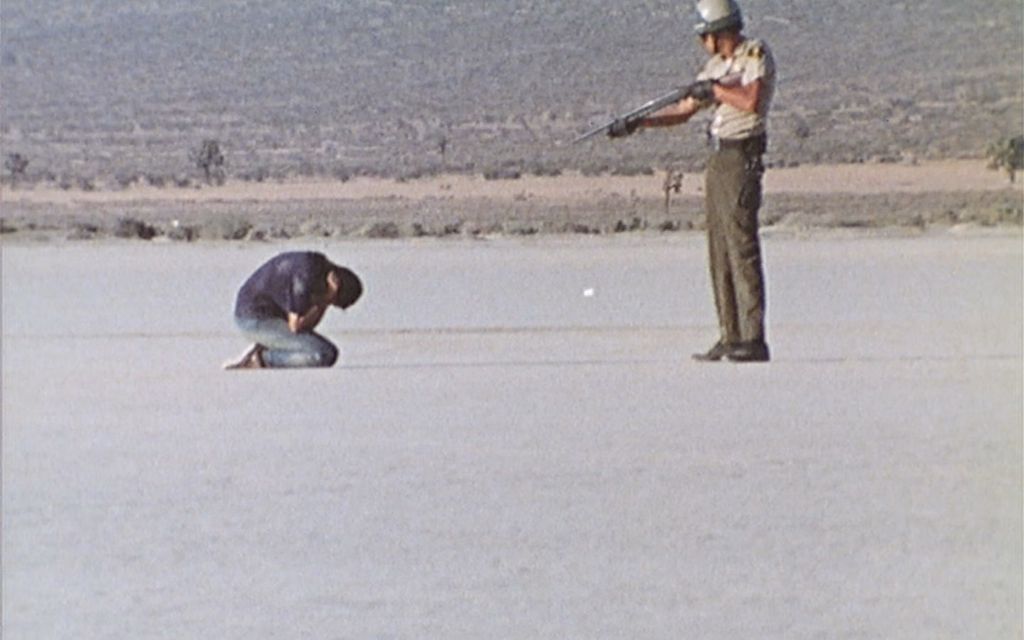
In British filmmaker Peter Watkins’ Punishment Park (1971), the depiction of violence in a mockumentary mode serves as an institutional critique of the United States government. Set in 1970 against the worsening Vietnam War, individuals convicted on the basis of their involvement with anti-war, feminist, civil rights and communist movements are given the option to serve their full sentence in federal prison or spend three days traversing fifty-three miles of desert under the scorching sun in the eponymous Punishment Park. If they successfully reach the American flag on the other side, evading the capture of National Guardsmen chasing them as part of field training, they will be set free—or so they’re promised. With a European crew behind the camera, the film alternates between two groups of people: those who are being interrogated and sentenced for their counterculture beliefs, and those who have chosen to risk crossing the desolate landscape.
Shot in an observational mode, the film shows detainees struggling to traverse the dry expanse of land without food or water. Some decide to escape at any cost while others simply give up. Between attempts to hide, run and combat the officers, participants provide direct interviews to handheld cameras, expressing their dissatisfaction with the state of democracy and comparing law enforcement agents to hired killers. At the end of the film, the pacifists who successfully reach the end are naturally rewarded by being shot. There was no chance of leaving Punishment Park alive.
Back in the makeshift tribunal tent, young radicals are questioned for activities considered a threat to national security, from dodging the draft to writing anti-war music to participating in the Black Liberation movement. Students, activists and militants appear in front of a committee for a hearing loosely based on the trial of the Chicago Seven, attempting to defend themselves against accusations and insults from conservatives intent on finding a guilty verdict. As the dissidents attempt to calmly state their political beliefs, they are all dismissed—one even placed in a headlock and choked—and sentenced to years in federal prison—although they also have the option of crossing the vast desert.
As far as the current administration in the U.S. is willing to admit, there’s no actual Punishment Park, though we can easily imagine the government instituting such a cruel solution to immigration and overpopulation in penitentiaries. By employing a faux documentary framework, we are invited to consider the real ways that the United States has committed human rights violations in the name of national security, which calls to mind abuses at Abu Ghraib, the enactment of the Patriot Act and the destruction of civil liberties for its citizens. Watkins’ film predicts the advent of competition shows like Survivor, in which civilians endure physical challenges in an isolated location for a prize that grants freedom. Fond of mockumentaries, Watkins commands this form with a high degree of proficiency to elicit feelings of horror and alarm at fictional dystopian events that intimately resemble reality.
In Spike Jonze’s Adaptation (2002), Charlie Kaufman’s fictional twin brother returns from a screenwriting seminar with a revelation, exclaiming, “See, it turns out, there hasn’t been a new genre since Fellini invented the mockumentary!” A reference to the 1970 Italian film The Clowns, this character rightly identifies the groundbreaking status of one of Federico Fellini’s late works. Featuring a cast of aging jesters across European traditions, the film is a love letter to the entertainers who reminded the filmmaker of eccentric figures from his childhood. In an effort to trace these nostalgic memories, he visits retired clowns in Rome and Paris, researching the current state of traditional circuses with the assistance of a film crew. They share dinners with animal trainers, reminisce about legendary performers, and interview circus historians, surveying the past and present of the comedic art.
One of the first feature-length mockumentaries, The Clowns blends narrative and autobiography to devise a form that deviates from a familiar style that had already been codified. Beginning with staged reenactments, Fellini appears, recounting his experience of the circus as a youth alongside acts by clowns, strongmen, conjoined twins, and vaudeville actors. Approximately a third into the film, we’re pulled into the current office of Fellini, where he recruits the help of a camera operator, sound technician, costume designer and script supervisor to investigate his query, “Where are the clowns of my childhood? Are they still alive? And that violent yet comic sense, that exhilarating buffoonery, does it still make people laugh?” At times, scenes appear as though they originated from his on-screen crew, while other shots depict the very production Fellini is working on, examining the filmmaking process itself.
Through the capacious nature of mockumentary, Fellini reflects on a preoccupation that has embedded itself in works across his career, such as La Strada (1954), La Dolce Vita (1960), 8½ (1963), and Amarcord (1973). Though the film initially entertains in a comedic register by way of its surface content, the form later shifts the tone to a more contemplative one that mourns the death of the circuses from his adolescence and suggests that his filmography has been an attempt to revive this loss. An unusual, delightful work that resists strict categorization, it seems appropriate that the mockumentary genre was perhaps invented for this purpose, as a testament to cinema’s ability to excavate truths as it tells stories.
Across countries and continents, mockumentaries have long been able to conjure reactions beyond the realm of comedy. With a slight shift, they can inherit dramatic or thrilling undertones, expanding the possibilities of the genre toward playful deception, institutional criticism or personal reflection. Dissolving the boundaries of fiction and nonfiction, mockumentary thrives between these modes, taking the shape of something as inspired and visionary as narrative filmmaking, as fluid and spacious as documentary.
The post Faking It: Mockumentaries Tell the Truth — or Do They? appeared first on POV Magazine.
Related Articles
Visions of the Croisette: The Ultimate Prediction for the 2026 Cannes Film Festival Main Competition
Caught between streaming algorithms and geopolitical upheaval, does cinema’s “sacredness” still matter? A Los Angeles–based team predicts the 22 Palme d’Or contenders for Cannes 2026—from PTA and Östlund to Panahi, Rohrwacher, and beyond.
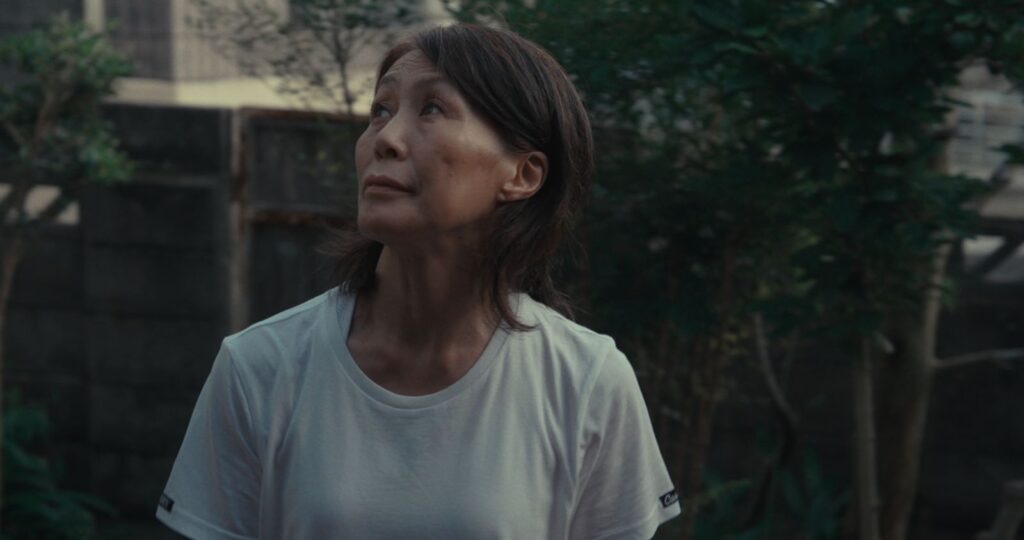
The Memory Palace: Or, If These Walls Could Talk
How films like Okuirmono, The Nest, and This House explore the histories embedded within the walls of our family homes. .

Exposing the Dark Truth of Digital Totalitarianism: Documentary 'Eyes of the Machine' Arrives in Prague as One World Film Festival Opens
Following its acclaimed premiere at IDFA Amsterdam, investigative documentary Eyes of the Machine screens at One World International Human Rights Documentary Film Festival in Prague, with Uyghur witness Kalbinur Sidik attending in person.